Ontology
The term ontology has its origins in philosophy, where it refers to a particular system of categories that accounts for a certain vision of the world. However, we limit our discussion to knowledge engineering, describing it in both theoretical and practical terms.
An ontology is an engineering artefact constituted by a specific vocabulary used to conceptualise a certain reality and a set of explicit assumptions about the intended meaning of the vocabulary.
Definitions & Terminologies
We now introduce the essential terminology as formulated by Guarino (1998). By establishing this rigorous theoretical foundation first, we can then smoothly transition to the practical frameworks required for applied ontology engineering.
Conceptualisation
The process of conceptualisation can be represented as the following ordered triple:
\[C=\langle D, W, \Re\rangle\]
where:
- \(D\) is the domain space, which is the set of all the elements.
- \(W\) is a maximum set of states possible for all n-ary relations in \(D\).
- \(\Re\) conceptual relations on the domain space \(\langle D,W \rangle\).
Ontological Commitment
In a logical language \(L\), with a vocabulary \(V\), we fix an intensional interpretation by means of a structure \(\langle C, \Im\rangle\), where \(C=\langle D, W, \Re\rangle\) is the conceptualisation and \(\Im:V\rightarrow D \cup \Re\) is a function assigning the elements of \(D\) to constant symbols of \(V\), and elements of \(\Re\) to predicate symbols of \(V\). This is the intensional interpretation of ontological commitment for \(L\). We use \(\cup\) here, because \(V\) is assigned to either \(D\) or \(\Re\) with function \(\Im\). The function \(\Im\) assigns meanings to vocabulary symbols by mapping constants to domain entities and predicate symbols to conceptual relations of the conceptualisation.
If \(K=\langle C, \Im\rangle\) is an ontological commitment for \(L\), then \(L\) commits to \(C\) by means of \(K\), while \(C\) is the underlying conceptualisation of \(K\).
Ontology
Given a language \(L\) with ontological commitment \(K\), an ontology for \(L\) is a set of axioms designed in such a way that the set of its models approximates as best as possible the set of intended models of \(L\) according to \(K\). An ontology \(O\) commits to \(C\) if:
- \(O\) has been designed to characterize \(C\).
- \(O\) approximates \(C\).
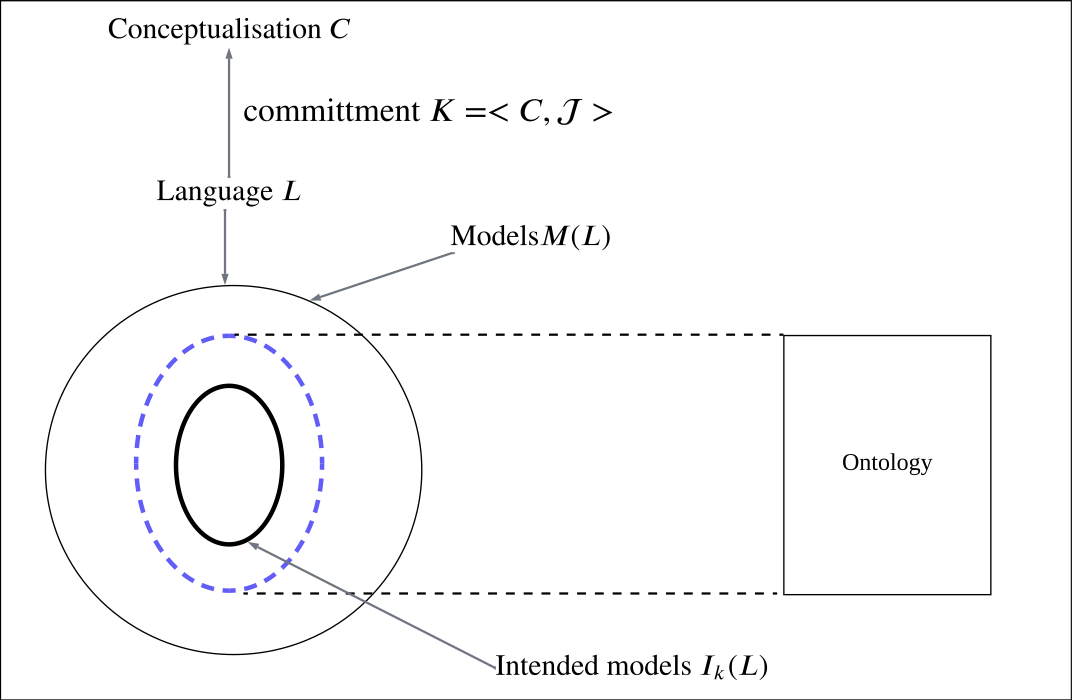
With this framework an ontology is a formal, explicit description of concepts in a domain of discourse. It is a set of logical axioms that accounts for the intended meaning of a formal vocabulary.
While Guarino provides a rigorous theoretical framework, Noy and Mcguinness (2001) introduce a complementary vocabulary for practical, scalable ontology development. They state that an ontology defines a common vocabulary to facilitate information exchange within a domain. It includes machine-interpretable definitions of basic domain concepts and their relations. This practical description relies on the following foundational elements:
- Concepts: These are the formal descriptions of the concepts in the domain of discourse. They are modelled in the ontology as classes.
- Properties: They describe various features and attributes of a concept; they are also called slots or roles.
- Facets: These are the role restrictions on the properties. The facet may apply these restrictions on either Value Type, Range of Values or Cardinality.
- Instances: The extensional realisations based on the intensional structures are called instances. For example, an ontology may define the class Car as an intensional concept that specifies the properties and structural characteristics that constitute cars. Individual vehicles, such as a particular Kia Sportage, correspond to instances that instantiate this class.
- Knowledge Base: The ontology, along with the instances of classes, forms a knowledge base.
Types of Ontologies
Ontologies can be classified according to the accuracy with which they characterise the conceptualisation they commit to, existing along a continuum defined by:
- Fine-grained Ontologies: A fine-grained ontology aims for maximum precision in describing the conceptualisation using a formal language. This is achieved by using more axioms, which limits the number of unintended models. It can also be achieved by adding more domains and relations, thereby increasing the complexity of the extensional structures that can accommodate such a dense ontological formulation.
- Coarse Ontologies: An ontology that opts for a minimal set of axioms and a simplified vocabulary. It allows for many unintended models and is built for efficiency, as fewer axioms or fewer domains and relations exist.
Based on the level of generalisability, the ontologies can be classified into the following types:
- Top-level ontologies: They describe general concepts which are independent of a particular problem or domain, space, time, matter, objects, events and actions. Basic Formal Ontology (BFO), Descriptive Ontology for Linguistic and Cognitive Engineering (DOLCE) (Borgo et al. 2022) are examples of top-level ontologies.
- Domain ontologies and task ontologies describe the vocabulary related to a generic domain (like medicine, or automobiles) or a generic task or activity (like extracting, or selling). They do so by specialising the terms introduced in the top-level ontology.
- Application Ontologies utilise both domain and task ontologies to describe roles played by domain entities while performing a particular task.
Ontology Development using Knowledge Engineering Methodology
There is no one correct method for modelling a domain. Among the viable alternatives, the suitability for the application and anticipated extensions determine the best solution. Getting to the optimal ontology is necessarily an iterative process.
The key decisions that drive the ontology development processes are: (i) Where will the ontology be applied, (ii) The level of granularity, which reflects the flexibility in the commitment to the conceptualisation required for ontology design, and (iii) Assessing the initial version against different conceptualisations in the field. The following steps form the basis of recommended steps for ontology development:
STEP 1. Determine the domain and the scope of the ontology
In this step, we determine: (i) the domain covered by the ontology, (ii) the purpose of the ontology, (iii) the types of questions to which the information in the ontology should provide an answer, and (iv) the users and maintainers of the ontology. One way to determine the scope of the ontology is to use competency questions (Monfardini, Salamon, and Barcellos 2023). This is a set of questions that a knowledge base based on the ontology should be able to answer. Once defined, it can also be used to test the adequacy of a designed ontology.
STEP 2. Accessing existing ontologies for suitability
One should always consider using the existing ontology that can address the requirements. Only in the cases where no ontology exists should one be developed from scratch. If the existing ontology has addressable shortcomings, then it should be modified.
STEP 3. Enumerate important terms in the ontology
Initially, it is important to get a comprehensive list of terms without worrying about the overlap between the concepts they represent, relations among the terms or any properties of the concepts.
STEP 4. Define and organise classes hierarchically
The process of defining classes and organising the classes hierarchically during the ontology development can be executed using the following approaches:
- Top-Down Development: It starts with the definition of the most general concepts first and then subsequently describes more specialised concepts. For example, if the goal is to develop classes for an ontology of wine and food, one would start with general concepts of Wine and Food, then move on to specialisation. The class Wine would be specialised by first creating its subclasses: White Wine, Red wine and Rose Wine. We can further categorise the Red wine class, for example, into Syrah, Red Burgundy, Cabernet Sauvignon, and so on, thereby moving toward even more specialised concepts.
- Bottom-Up Development: This approach starts with defining the specific classes as the leaves, then groups them and defines a general class. It is methodologically inverse to Top-Down Development, i.e., we would first define Syrah, Red Burgundy, and Cabernet Sauvignon, and then group them under a common superclass Red Wine.
- Combination Development: This approach integrates elements of both the bottom-up and top-down approaches by identifying the most important concepts first—whether general or specific—and then either specialising or generalising as necessary. For instance, one might start by defining key concepts such as Cabernet Sauvignon and Wine, and then expand into subclasses or generalise them, grouping related concepts as appropriate to create a more versatile structure.
STEP 5. Assign properties to the class and define the facets
Once the classes are defined, the next step is to populate the slots or the properties of these classes. For the Wine and Food example the properties associated with the classes might represent color, body, flavour, sugar, content, etc. Once the properties are listed, they must be assigned to the relevant classes. There are two types of properties: (i) Data Property, which describes the intrinsic property of the class, and (ii) Object Property, which describes the relationship between two objects of different classes. The facets represent the specification of the values that can be used to populate the Data Properties. They can be one or all of the following:
- Cardinality: It defines the number of values a property can have. It may be described by minimum (N) and maximum (M) cardinality to describe the number of slot values more precisely. Minimum cardinality of N means that a slot must have at least N values. For example, the grape slot of a Wine has a minimum cardinality of 1: each wine is made of at least one variety of grape.
- Value Type: It describes the type of data type of values the properties can take.
- Domain & Range: Domain describes the classes that can use the data property, and range describes the restrictions in the property values.
Applications of Ontologies
The scope and maturity of ontological applications vary considerably across fields, from large-scale biomedical terminologies to tightly scoped domain constructs, and understanding this landscape contextualises the role of more targeted ontological contributions such as the one developed in this thesis.
Large Scale Ontologies with Multi-Decade Maintenance
One of the most extensively developed families of applied ontologies is found in the biomedical sciences. The Open Biological and Biomedical Ontology (OBO) Foundry (Smith et al. 2007) provides a coordinated suite of interoperable ontologies, of which the Gene Ontology (GO) (Ashburner et al. 2000) is among the most widely used, providing a controlled vocabulary for biological processes, molecular functions, and cellular components across organisms. These biomedical ontologies are notable for both their scale (GO alone contains over 40,000 terms) and their institutional maintenance infrastructure, features that are rare outside the life sciences and that few domain-specific ontologies can be expected to replicate.
In the financial and legal domains, ontologies have attracted growing interest as a means of formalising regulatory and contractual knowledge. The Financial Industry Business Ontology (FIBO), developed by the Enterprise Data Management Council and standardised through the Object Management Group, provides a modular OWL-based representation of financial instruments, legal entities, and market processes (Bennett 2013). FIBO has been adopted by major financial institutions as a data governance framework, enabling cross-system interoperability and regulatory reporting. In the legal domain, efforts such as LegalRuleML (Athan et al. 2015) and the Legal Knowledge Interchange Format have sought to represent normative reasoning and deontic logic within formal ontological structures, though full-scale deployment in live legal systems remains limited. These applications underscore a common motivation: in high-stakes, highly structured domains, informal or purely statistical representations of knowledge are insufficient, and ontological precision serves a governance function as much as a scientific one.
Semantic Web Ontologies
The Semantic Web tradition has produced a third influential strand of ontological application, centred on the OWL and RDF standards (Mcguinness et al. 2004) and realised at scale in projects such as DBpedia (Auer et al. 2007) and Wikidata. DBpedia, by extracting structured information from Wikipedia infoboxes and encoding it in RDF, made available a large, interlinked knowledge graph that has been used extensively in entity linking, question answering, and information retrieval research.
Natural Language Processing
In natural language processing and affective computing, ontological resources have played a similarly enabling role, though somewhat more modestly. SentiWordNet (Esuli, Sebastiani, et al. 2006) extended the WordNet lexical database with sentiment polarity scores, providing a structured resource for opinion mining that predated the widespread use of neural approaches. More recent work has sought to formalise opinion and affect at a structural level, moving beyond lexicons toward relational representations of the components of subjective language, a trajectory that informs the construction of the UOC ontology developed in this thesis.
It is important to acknowledge, however, that the utility of an ontology is not straightforwardly proportional to its scale. The large ontologies described above (GO, FIBO, DBpedia) are the products of decades of coordinated community effort, sustained institutional investment, and, in many cases, regulatory mandate. As opposed to these multi-decade domain-specific ontology infrastructures, the ontology developed in this thesis is a domain ontology of a modest scale. Its usefulness is intended for conceptual precision, which involves structural coherence within a targeted scope of opinion analysis.
Ontology in the Era of LLMs
This distinction has become particularly salient in the context of large language models and contemporary AI systems. LLMs, trained on vast corpora, have demonstrated remarkable capacity for implicit knowledge representation, raising the question of whether formal ontologies retain utility in an era of such models. The emerging consensus in the research literature suggests that they do, though the nature of that utility has shifted. Ontologies have been shown to improve LLM performance through structured prompting and retrieval-augmented generation, to provide interpretable scaffolding for knowledge graph construction and verification (Kommineni, König-Ries, and Samuel 2024), and to serve as evaluation frameworks against which the implicit knowledge of language models can be assessed (Alivanistos et al. 2022). Rather than being supplanted by neural approaches, formal ontological representations increasingly function as complementary structures providing the explicit, verifiable semantics that distributional models alone cannot guarantee.
In NLP tasks specifically, where the boundaries between sentiment, opinion, and emotion are conceptually contested, ontological grounding offers a principled means of disambiguating constructs that might otherwise be conflated in purely data-driven frameworks.